Field Note · Kunming · Goji Vol.3

Over the Counter

#Dialogue#SpatialDesign
Place Kunming Bistro, upstairs off Wenlin Street  ·  With the owners, behind their own counter  ·  When July, during Goji's Yunnan gathering

A deep conversation on spatial design with a local shop owner — held in the best possible seat for it: across the counter of a tiny upstairs bistro, while the owners cooked the mushrooms they are quietly obsessed with.

Goji Vol.3 · Yunnan
On tape 01 · The conversation

“Red umbrella, white stem”

红伞伞,白杆杆 — the folk rhyme every Yunnan child knows, a sing-song warning about which mushrooms put you in the ground. It surfaces within minutes of sitting down, whisky flight already on the table.

This is the conversation itself, on the bistro's terrace under the canvas awning: ganba mushroom in hand, subtitles running in both languages, and the owners walking us through what they thought about when they were designing the store. Two minutes; unmute it — the room talks.

On tape 02 · Street level

Nightfall on Wenlin Street

昆明 — the city's name, brushed in a ragged, oracle-bone hand across the bistro's red street front, over a fridge of house infusions glowing at the lane.

This is the first thing the shop says to the street — before a menu, before a door. Press play; the evening starts here.

On tape 03 · The shelf

A slow pan across the house memory

Tea tins, white porcelain jars, gilded bells, wooden boxes with their labels going soft — one shelf holding more biography than most about-pages.

Everything the owners collect ends up in the room, and the room is better for it. The photos below are what the camera found when it stopped moving.
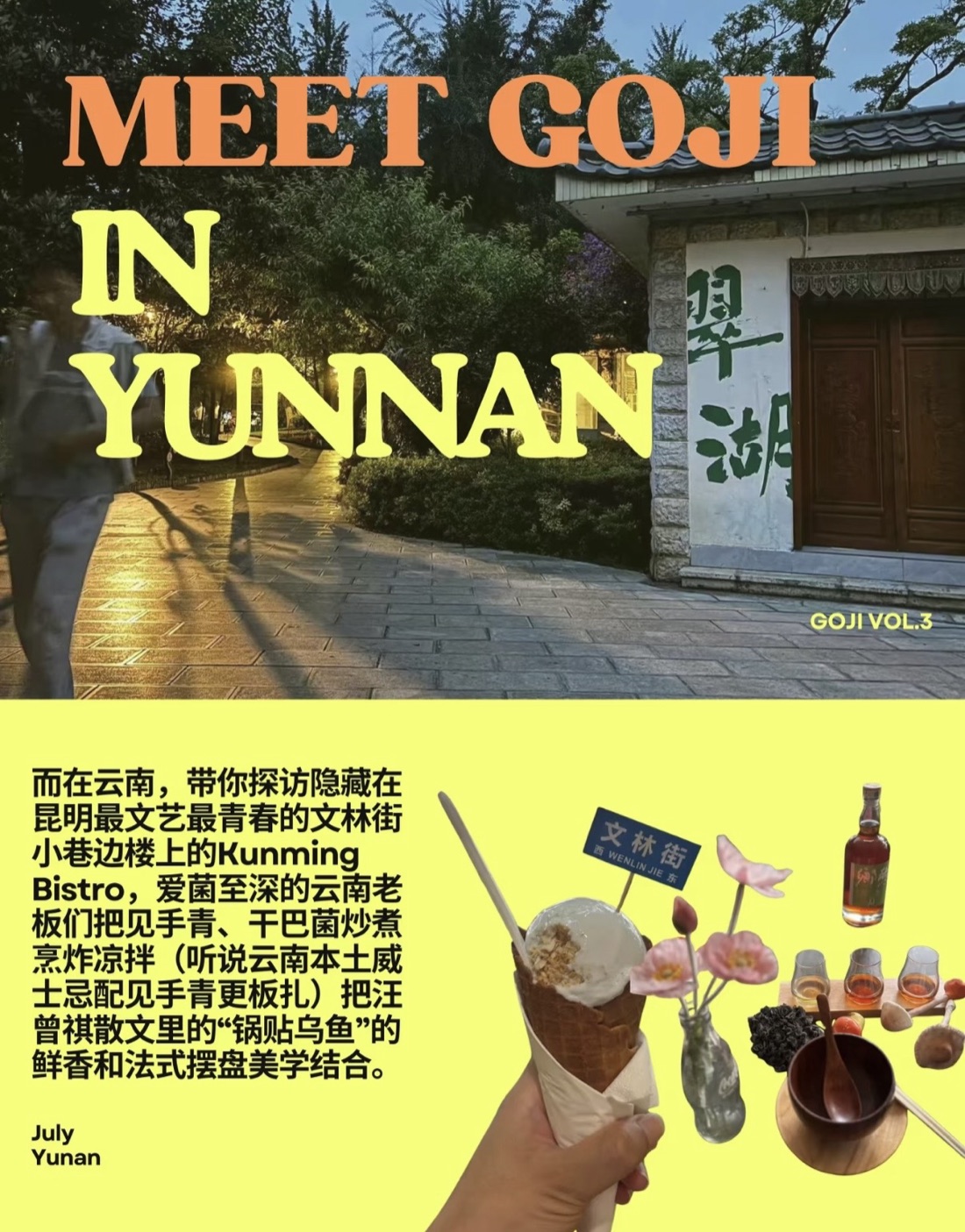
Meet Goji in Yunnan — Vol.3 zine cover with Green Lake at dusk
vol.3 — July, Yunnan; Green Lake at dusk
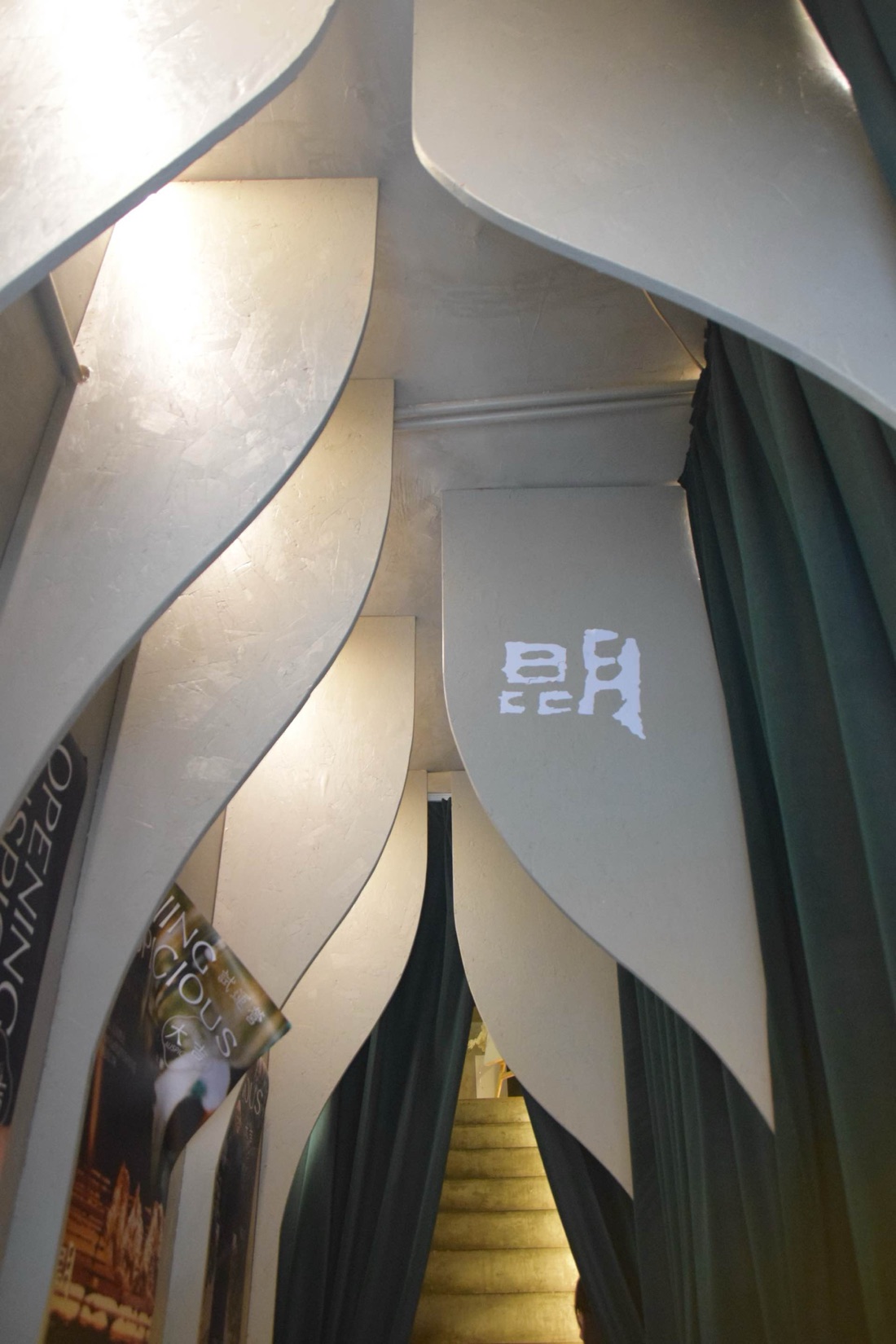
Curved plaster fins over the bistro's entry corridor
the entry — plaster fins like the gills of a mushroom cap
The find

Upstairs, off Wenlin Street

Wenlin Street is Kunming's most artsy, most youthful stretch — a lane of bookshops, cafés, and students a short walk from Green Lake. Kunming Bistro hides upstairs in a small side alley, behind a curtained corridor you would walk past twice before finding.

The owners are mushroom people to the core. Their kitchen runs Yunnan's famous wild fungi — 见手青 and 干巴菌 — through every method the province knows: stir-fried, boiled, deep-fried, tossed cold. The plating, though, is French. The stated ambition: take the freshness you read about in Wang Zengqi's essays and give it composition.

We came for dinner during Goji's July gathering in Yunnan. We stayed for a long conversation across the counter — about why the room looks and moves the way it does. This note is what we took away.

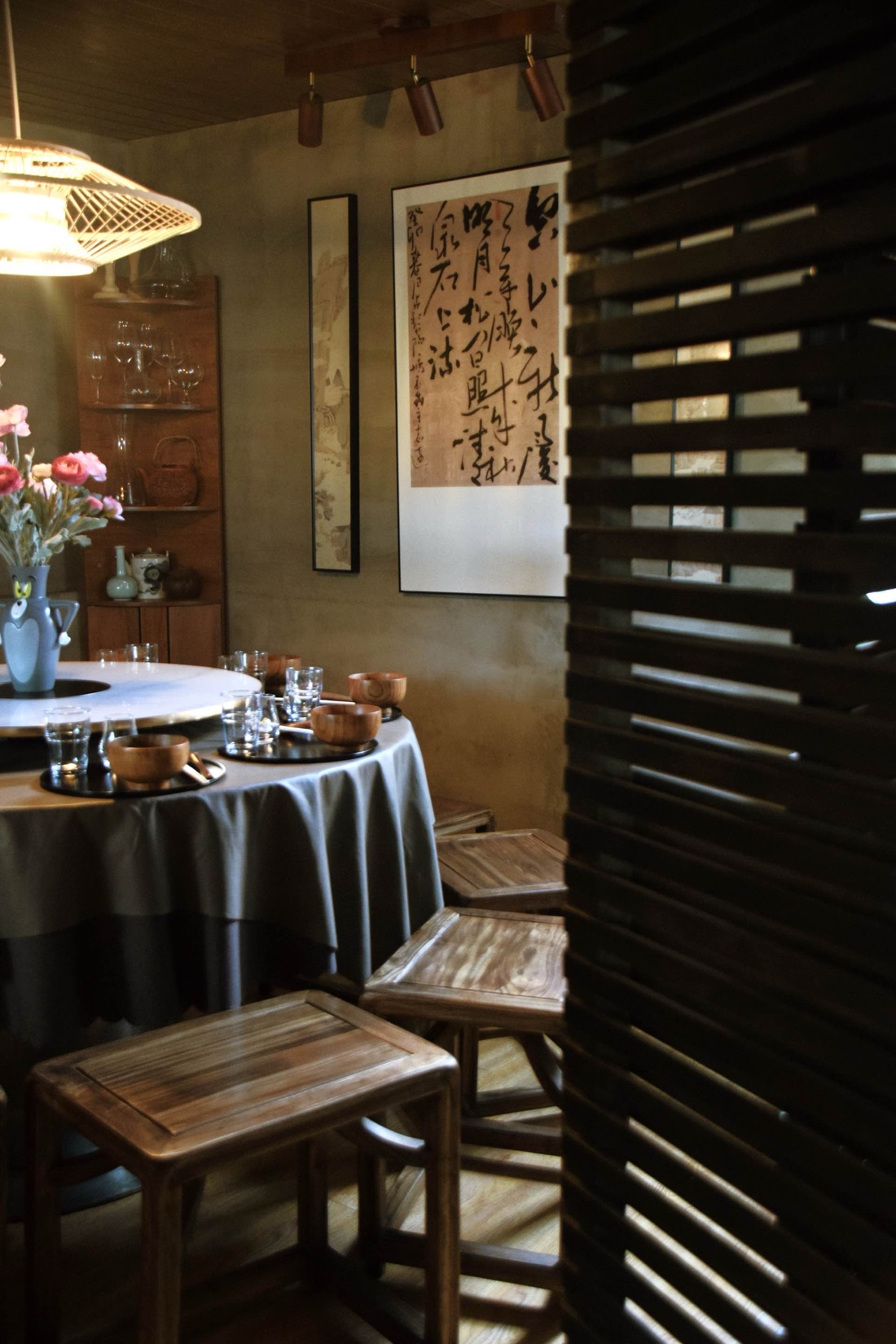
The private dining room — round table, linen, wooden bowls, calligraphy
the back room — one round table, wooden bowls, grass-script on the wall
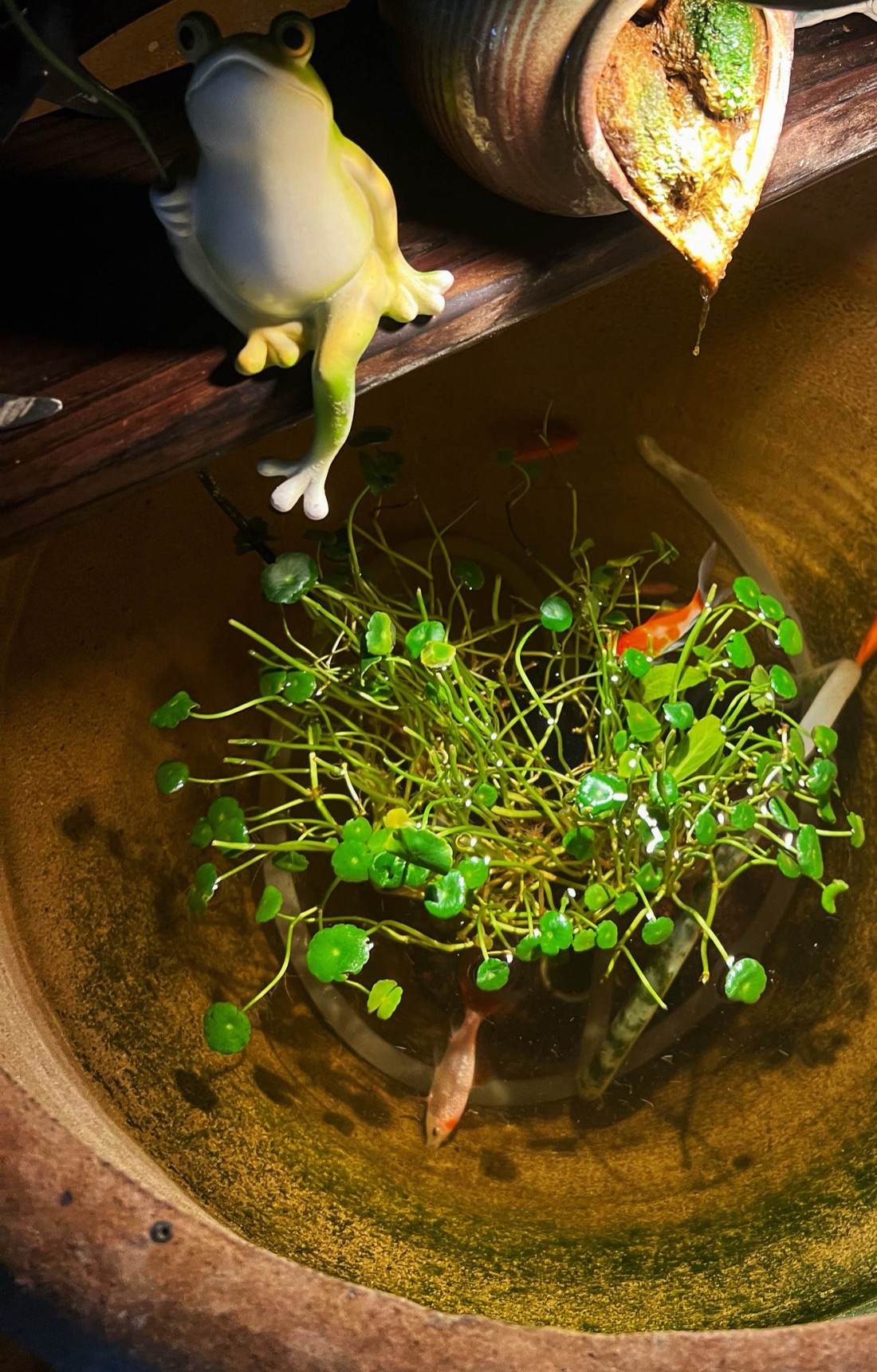
A ceramic basin with goldfish, pennywort, and a ceramic frog on the shelf
the residents — goldfish, pennywort, one unbothered frog
The conversation

What a small room can say

Retail design usually gets discussed in showrooms. It lands differently when the designer is also the cook, the bartender, and the person who waters the plants — and the showroom seats maybe twenty. Three threads from the evening:

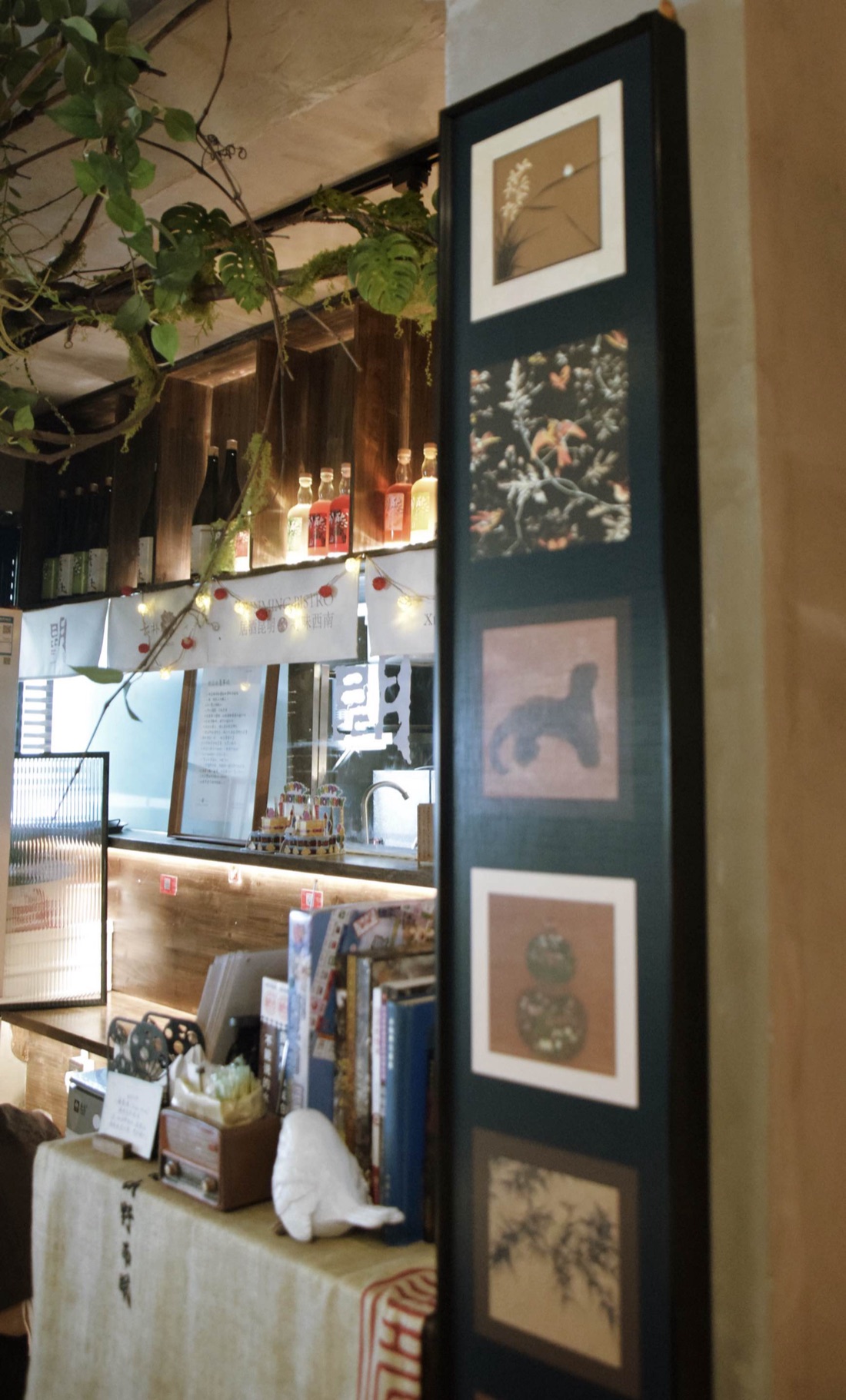
The bar — house-infused bottles, a noren curtain, books and a bird sculpture
the counter — infusions above, books below
Thread 01 · The counter

The counter is the interface

见手青 · 干巴菌 — Yunnan's celebrity wild mushrooms: the bolete that bruises indigo at a touch, and the dense, pine-scented ganba fungus that locals argue is worth more than meat. (House intelligence: Yunnan's own whisky pairs with 见手青 even better — “更板扎,” as Kunming slang certifies.)

Everything in the shop routes through the counter: orders, infusions, opinions, recommendations. The owners treat it less as furniture than as the room's interface — the place where the shop talks to you. Sit there, and the menu becomes a conversation.

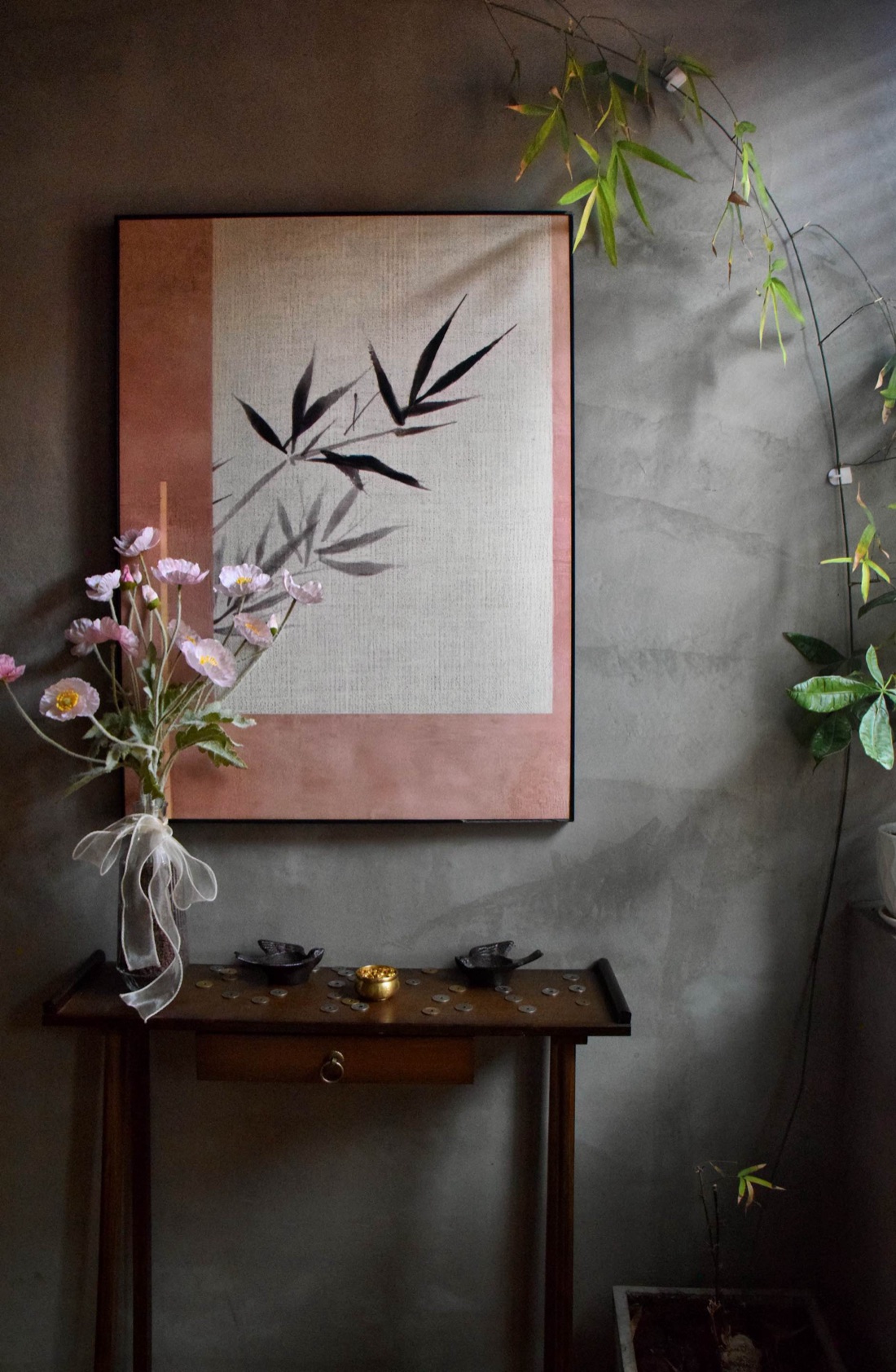
A console with pink poppies, old coins, and a bamboo ink painting
one wall, one painting, a scatter of old coins
Thread 02 · The texture

Wang Zengqi's freshness, plated French

汪曾祺 — the essayist who made Kunming's rain, mushrooms, and market stalls famous in Chinese literature; his pan-fried wuyu (锅贴乌鱼) is the dish the owners keep citing as a benchmark for freshness.

The room makes the same move the kitchen does: local material, composed presentation. Hand-troweled grey plaster and dark wood lattice carry ink paintings hung like gallery pieces, pink silk borders against raw walls, old coins scattered where a cash tray might be. Nothing is themed; everything is arranged.

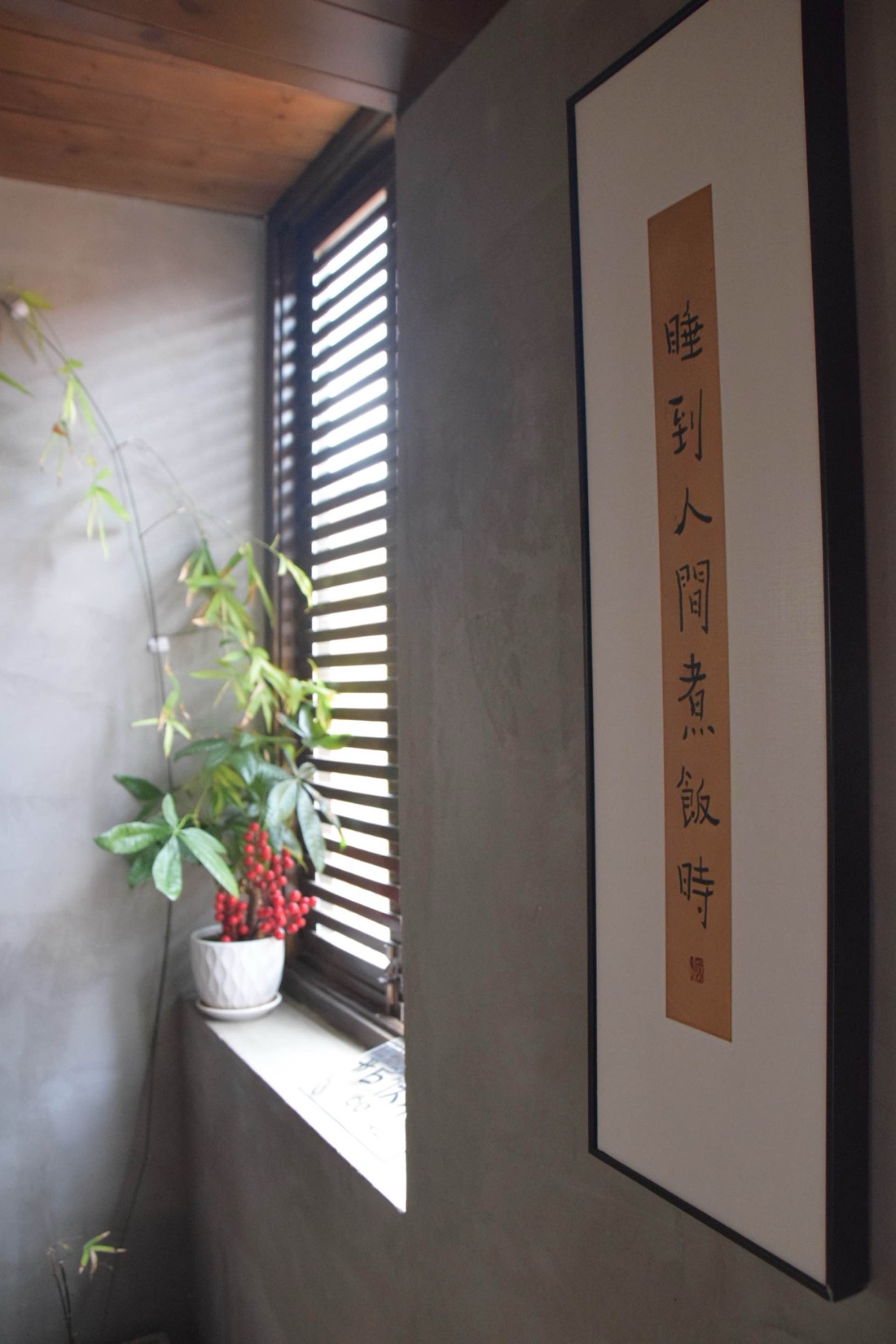
A framed calligraphy scroll beside a window with plants
the house motto, framed by the window
Thread 03 · The tempo

“Sleep until it's time to cook rice

睡到人间煮饭时 — the calligraphy by the window, and the closest thing the shop has to a manifesto: sleep until the world starts cooking rice.

Kunming runs slower than the coastal cities, and the bistro is designed to protect that tempo rather than fight it — soft lamplight, a goldfish basin, a ceramic frog loitering on a shelf. The owners' point, made in plaster and pennywort: a shop's real product is the pace it puts you in.

A shop this small can't afford decoration. Everything in the room is a point of view.

What we took away

Space is the slowest conversation

The best interviews happen across counters. No meeting room would have produced this conversation. The owners talked about design while doing the thing the design exists for — and every claim could be checked by looking around.

Local does not mean rustic. Wild mushrooms with French plating, raw plaster with silk-bordered ink paintings: the bistro's whole argument is that regional material deserves deliberate composition. It is the same argument Goji makes about travel.

Small rooms make strong filters. Twenty seats up a hidden staircase select for people who looked. For Goji's Yunnan gatherings, that's the venue brief now: rooms with an owner, a counter, and an opinion.